Order of Operations Worksheets (PEMDAS) with Answers
Have you ever tried to solve a math problem and ended up with a different answer than your friend? The reason is often the order of operations. In math, we cannot just solve in any order we like. There is a special rule that guides us. That rule is called PEMDAS. Once you understand PEMDAS, solving long equations becomes clear and simple.
Check Also: Adjectives That Start with L

Breaking Down PEMDAS
PEMDAS is an easy way to remember the order of operations. Each letter stands for a step.
- P → Parentheses: Solve what is inside brackets first.
- E → Exponents: Next, handle powers and square roots.
- M and D → Multiplication and Division: These come after exponents. Work from left to right.
- A and S → Addition and Subtraction: These are the final steps, again from left to right.
Think of PEMDAS like a traffic signal. It tells you which turn to take first and which to wait for.
PEMDAS vs BODMAS
In some countries students learn the term BODMAS. It stands for Brackets, Orders, Division, Multiplication, Addition and Subtraction. The meaning is the same as PEMDAS. Both follow the same math rules. Only the letters are different.
PEMDAS Steps Explained
To use PEMDAS correctly:
- Look for parentheses and solve them first.
- Then calculate exponents.
- Next, do multiplication and division in the order they appear from left to right.
- Finally, handle addition and subtraction from left to right.
This order prevents confusion and ensures everyone gets the same correct answer.
Examples of PEMDAS
Let’s solve a simple one:
8 + 2 × 5
First multiplication → 2 × 5 = 10
Then addition → 8 + 10 = 18
Another one:
(6 + 2)² ÷ 4
First parentheses → 8
Then exponent → 8² = 64
Then division → 64 ÷ 4 = 16
Notice how the answer changes if we skip a step or solve in the wrong order.
PEMDAS Practice for Students
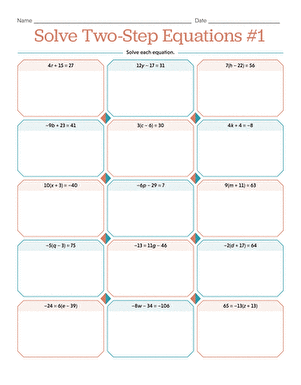
Students often learn better with practice. Simple worksheets with problems like 12 ÷ (2 + 4) × 3 or 5² + 10 ÷ 2 help them apply PEMDAS correctly. Teachers also give puzzles where kids circle which step comes first. Learning in small steps makes it easier to remember.
PEMDAS in Algebra and Equations
PEMDAS is not only for numbers. It also works in algebra. When solving x + 3(2x – 4) = 10, you must follow the same rule. Parentheses first, then multiplication, then addition. Without PEMDAS, algebra problems become messy.
Teaching PEMDAS
Teachers often use fun tricks to help kids remember PEMDAS. A famous one is the phrase “Please Excuse My Dear Aunt Sally.” Each word stands for a step in PEMDAS. Activities like coloring worksheets or group games make the learning fun and less stressful.
Common Mistakes and Fixes
Students sometimes:
- Add before multiplying
- Forget exponents
- Solve strictly left to right without following rules
The best fix is to slow down and check each step carefully. Writing small notes above each number, like P, E, M, A, helps keep track.
Conclusion
PEMDAS is not just a rule, it is the backbone of solving math problems correctly. It tells us the exact order so everyone gets the same result. From basic arithmetic to complex algebra, PEMDAS guides us every time. So the next time you face a long equation, ask yourself: Did I follow PEMDAS? With practice, the answer will always be yes.